Yesterday LCDR "Vic" Vale and I hitched a ride on a Blackhawk helicopter down to a construction and development conference in Khowst Province in the southeast end of the country. I'll be posting pictures from the flight there and back in the next day or two (I took a lot), but for now here's the Cliff's Notes version of what I learned while I was there:
Trees will win the war:
Afghanistan has a long history of success with tree-based agriculture. War is hard on trees, so after thirty years of conflict in the country there aren’t a heck of a lot of them left. Before the Soviet invasion, Afghanistan grew some of the world’s best walnuts, pistachios, almonds, apricots, and pomegranates (including a seedless variety). The widespread destruction of the local forests and orchards has led to the usual problems associated with deforestation; topsoil erosion, water runoff, air pollution, and so on.
It is not far-fetched to say that trees will save this country. The international community has implemented numerous programs geared toward the planting of fruit trees for commercial use and fast-growing trees such as poplar for lumber and firewood. In some provinces there are even programs in place to replant wild forests, though their limited financial benefits have mostly kept these on the backburner in favor of more immediately profitable projects.
Grapes:
Grapes are one of the most successful crops in the country and have been for a long time. When Alexander the Great’s armies invaded, his staff identified at least a dozen different varieties of grapes. Seedless grapes were invented in Afghanistan. Much of the world’s raisins come from Afghanistan. Despite this legacy, there are many basic concepts they have not yet grasped. For example: trellises. In California whenever you see a vineyard it is trademarked by rows of trellises that stretch for miles and miles. In Afghanistan most grapes are grown on the ground, making them more prone to pest infestation and yielding less fruit.
Alternative crops are the key to eradicating opium:
Every year in Afghanistan, local farmers grow roughly $4Billion worth of Opium poppies. That $4Billion worth of poppies becomes $16Billion worth of heroin on the streets of Europe and the United States. Since the demand for this crop will remain high, the only best way to get the locals to stop growing it is a coupling of a “sharper stick and a bigger carrot.” The ideal way is to make sure that everyone knows that poppy fields will be burned while also making sure everyone knows that we will help them if they opt to plant alternative crops that will yield a higher profit instead. Opium is very easy to grow, so we have to work to incentivize the growth of more challenging crops (pomegranates, saffron, apricots, etc).
Afghans are very nationalistic about their food:
An Afghan will pay more for an egg laid in Afghanistan than they will for an egg laid in Pakistan. The anecdotal ethnic-suspicion-fueled rumors that Pakistanis try to poison Afghans help to drive this aspect of the market. There are a few programs in place to train local farmers and widows in the care and feeding of chickens, but they could all stand to be expanded.
There’s no shortage of water:
Despite the general impression to the contrary, there isn’t a shortage of water in Afghanistan. In fact, there is more water per capita in Afghanistan than there is in Switzerland. The problem is that all of the water flows freely out of the country and there are not very many people in the country with water management knowledge. The US Army Corps of Engineers has been trying for some time to get funding for a nationwide watershed survey in Afghanistan that will allow them to plan the construction of reservoirs, and dams as well as hydroelectric and irrigation projects. A number of international donors have expressed an open willingness to fund the myriad number of water usage projects that this survey will provide for. So far, nobody is willing to shell out the $4.5million required to conduct the survey itself.
Afghans love sheep and goats:
In addition to the plant-based agriculture, the local economy depends a lot on animal-based agriculture. This is primarily comprised of goats and sheep. Wool from the Ghazni province (in southeast Afghanistan) is world-famous. The main obstacle to developing this niche in the market is that the country lacks the infrastructure necessary to effectively distribute their products. Most Ghazni wool is exported and made into finished products in Pakistan. It’s not uncommon to find rugs in high-end department stores worldwide marked “Made in Pakistan, 100% Ghazni wool.”
In addition to the wool, Afghanistan makes some of the world’s best cashmere. Cashmere comes from certain types of goats and the Afghans have a shit ton of them. The main problem with their production is the manner in which they harvest it. To get the optimal yield of cashmere from your goat, you need to brush out the fine undercoat and use that part. When the Afghan goatherds do it, they shear the goats and then try to separate the fine undercoat from the long, coarse, topcoat. This is labor-intensive and consumes much of the profit that would come from the final product. How much profit? One ton of raw cashmere is worth approximately $12,000US. In a country where the average person earns barely one dollar a day, this is a very significant amount of money.
One of the more successful projects instituted by USAID (the United States Agency for International Development) has been the development of Veterinary Field Units. These are one-man travelling vaccination stations built into a truck with a solar-powered refrigerator that can move from village to village and treat livestock. Each one is basically a self-contained, Afghan-owned veterinary clinic. This leads to the next problem…
Charity is ruining this place:
Whenever a foreign donor comes along and gives something away for free, it puts a local out of business. Case in point: wheat seed. Last year there was a big push to distribute wheat seed to help the locals kick off their planting season. As a result, none of the farm supply distributors in the country carry wheat seed anymore. Since the international community is giving it away for free, there’s no longer any profit in it. As a result, we’ve inadvertently shattered a little piece of the privately developed supply infrastructure.
This same thing happens whenever we show up and do a VETCAP (essentially a free visit from Army veterinarians) or MEDCAP (Army doctors) or hand out food as part of a humanitarian aid project. While all of these things make us feel good in the short term, over the long term they undermine the locals’ ability to provide these goods and services for themselves. This is why we need to stick closer to our own policy of providing direct assistance in only the most extreme cases, while simultaneously supporting the development of infrastructure that will allow Afghans to buy Afghan products from Afghan sources. Our aim should be to increase the value chain and improve Afghan business practices. We need to stop fixing problems for a day or a month and set them up to be fixed for decades to come.
Women’s empowerment has a long way to go:
In a contest broadcast on Tolo Television Network, contestants were brought in to showcase their business plan proposals in the hopes of winning cash prizes to put toward the establishment of their businesses. The second place winner was an Afghan woman who had a very promising business model for a textile factory. Although she always appeared on television covered in her burkha, residents in her village were able to figure out who she was and set about regularly attacking and beating her father and her brother. Local police refused to intervene unless they were given half of her $10,000 prize as “protection money.”
This is a high-profile example of misogynistic sentiment in the country, but the driving forces behind it are not especially rare. While it is imperative that we strive to improve women’s standing in Afghanistan, it is vital that we remain sensitive to the long-standing cultural resistance to women’s rights. Too much too soon will only make it harder.
There was a lot of useful information that was put out and there was an official photo taken of the whole crowd that showed up (suitable for framing). Unfortunately Vic and I had to catch a ride home before the conference was over, so we missed a couple of the lectures.
About Me

- THORSSOLI
- I make toys for kids who don't want to grow up. I'm on the lookout for new projects. If you're interested in commissioning me to build something ridiculous, shoot me an email.
Saturday, March 7, 2009


Monday, March 2, 2009
Save the Whales of Afghanistan*
Over three decades of war have wrought death and destruction across the nation, but nowhere are its effects more apparent than among the Afghan whale population. Their numbers have diminished so much that nowadays most people will tell you that they don't even exist. At the rate they’re being killed today, this common misconception could become a cold prophetic truth as the last species of Afghan whales become extinct by 2025.
In prehistoric Afghanistan, the nomadic Dirkadurka tribes would follow the whale herds across the desert, hunting them for sustenance and living in harmony with nature. But as the world's great empires began to vie for power in the region, foreign invaders with more devastating weapons began to harvest the whales and even kill them for sport.

A trio of British Army officers posed atop a trophy-sized Kandahar Humpback Whale bull, circa 1881.
In prehistoric Afghanistan, the nomadic Dirkadurka tribes would follow the whale herds across the desert, hunting them for sustenance and living in harmony with nature. But as the world's great empires began to vie for power in the region, foreign invaders with more devastating weapons began to harvest the whales and even kill them for sport.
A trio of British Army officers posed atop a trophy-sized Kandahar Humpback Whale bull, circa 1881.
Now, as the centuries have passed, the detrimental effects of prolonged warfare, poaching, widespread deforestation, soil erosion, agriculture, and over-grazing have decimated these burrowing monuments to graceful Nature.
Here we see a rare photo of "Kandy," the world's most famous Kandahar Humpback, in mid-broach:

Once great herds of beautiful creatures like her would migrate across the deserts of Kandahar, Helmand, and Nimruz, stretching as far as the eye could see. In recent decades these battle-scarred regions along the Afghan-Pakistan border see fewer and fewer new calves every year. Now she is one of only seventeen alive in the wild today, and there are too few remaining for there to be any hope of repopulating the species. Click here to listen to her soulful, haunting song.
In 1992, Afghan whalers killed the last Oruzgan Long-Finned Whale the world ever saw:

She was murdered while carrying an unborn calf. Killed only for her ambergris, which would be sold on the black market for use in perfume. Despite being one of the earliest to be placed on the endangered species list, under the lawless Taliban regime poachers were free to kill as many as they liked. Now they are only a memory, the stuff of local legend and the occasional rare photograph.
Here we see a rare photo of "Kandy," the world's most famous Kandahar Humpback, in mid-broach:
Once great herds of beautiful creatures like her would migrate across the deserts of Kandahar, Helmand, and Nimruz, stretching as far as the eye could see. In recent decades these battle-scarred regions along the Afghan-Pakistan border see fewer and fewer new calves every year. Now she is one of only seventeen alive in the wild today, and there are too few remaining for there to be any hope of repopulating the species. Click here to listen to her soulful, haunting song.
In 1992, Afghan whalers killed the last Oruzgan Long-Finned Whale the world ever saw:
She was murdered while carrying an unborn calf. Killed only for her ambergris, which would be sold on the black market for use in perfume. Despite being one of the earliest to be placed on the endangered species list, under the lawless Taliban regime poachers were free to kill as many as they liked. Now they are only a memory, the stuff of local legend and the occasional rare photograph.
Despite their impending extinction, the local government has no plans to ban the hunting of whales in Afghanistan. Plus, even as their prey continues to diminish in numbers, Afghan whalers are constantly developing more effective tools to massacre them. Without your help, there will be no end to the carnage.


A group of Pashtun whale poachers (left) sets out for their early-morning hunt. Vehicle-mounted harpoon guns like that shown at right have killed countless whales in the unregulated wilds of Afghanistan.
The Hindu Kush Narwhal, the smallest species of Afghan whale, was completely wiped out as recently as 1997. They were killed for their luxurious hides and their tusks which were believed to have powerful aphrodisiac effects. What finally spelled their ultimate doom however, was the popularity of Dorsal soup in eastern Asian countries. It took five of these peaceful, defenseless animals to make just one quart. Now all that remains are a few scattered bones in the heights of the Hindu Kush Mountain Range.

An anonymous Taliban fighter seated alongside some Hindu Kush Narwhal vertebrae near the Khyber Pass. While they were still alive, these animals were so reclusive that they were never photographed. Now they will never be seen again.
It's not too late to save what's left of the Afghan whales. Every dollar brings us closer to our goal of building the Chakhansur Whale Reservation, a vast expanse of open terrain in the Nimruz Province where Afghan whales will once again be able to roam, free from the predations of Man. There we can continue research to benefit the Afghan whales and educate the world.

With your donation, we can ensure that these amazing animals don't become a thing of the past.

*In case you haven't figured it out, this entire post is satirical. While it is potentially in poor taste, it's intended to be funny. There are no whales in Afghanistan. If you're foolish enough to actually donate to this cause, I'll gladly relieve you of your money. Just know that whatever you donate will go directly into my pocket and I will be personally spending it as wastefully and frivolously as possible. Your donations are NOT tax-deductible.
Sunday, March 1, 2009
Return of the Revenge of the Son of the Friday Bazaar in Kabul, Part XIV
Fridays tend to be slow days in the office for some reason. Something about Muslim fundamentalists being less likely to blow shit up during the Muslim version of Sunday. I don't really know.
Anyway, since it's a slow day in the office, that's when the custodial staff comes in to "clean." The word "clean" doesn't seem to translate very well into any of the local languages. While you or I might take it to mean the removal of dust and dirt and disease-laden filth, the cleaning staff here seems to think of it more like a generalized redistribution of funk.
Take for example the tiled floors. When I've got a hard, non-carpeted floor to clean I figure it needs frequent sweeping and periodic mopping. During the mopping I use bleach and hot water. I take it as my mission in life to kill or destroy anything on that floor that could be seen as unsanitary or unsightly.
The locals hired to clean here have a much different modus operandi. In order to "clean" the tile floor, they pour some dirty water on it, then use a squeegee to squeege the dirt and water and whatever else into all of the grout and seams and cracks and pores.

In the end, their labors net a floor that is not only dirty, but wet too. It's like trading in your day-to-day, household dust for a big puddle of mud spread evenly throughout your home. The goal seems to be to look busy as opposed to actually getting anything done.
I don't understand.
On top of this flawed methodology, the only cleaning product they seem able to procure (apart from dirty water) is the alcohol-based hand sanitizer spray that we stock in the bathrooms here. It has one of the worst, God-awful smells I've ever found tied to the notion of cleanliness and they spray it on everything in the entire camp. During cleaning hours in the morning, I can't even walk into the building I sleep in without gagging.
In fact, the best way I've found to cope with the local version of "cleaning" is to just not be around it. Fortunately when the Friday cleaning crew comes around I have a ready-made escape.
Fridays are when a sanctioned group of merchants are allowed to set up shop on our athletic field and we're allowed to go out and get haggled for money. I usually end up ambling out there with any of the other guys from my office:

Once the bazaar is set up, you can find everything from pirate DVDs to gemstones. There are booths selling rugs and carved stone and woodcrafts and Pashmina silks and antique rifles left behind by the Brits in the 1800's. One of the most intriguing is a booth set up to sell the products made by Afghan women as a part of a SEATTLE-BASED CHARITY PROGRAM. But this week, for no reason I could account for, I decided I needed a nifty hat:

My hat was pretty damned cool, so Major Cheff decided that he too needed a nifty hat:

He failed to find a nifty hat even half as nifty as my nifty hat though, so I lent him one for a photo:

Nifty though they may have been, neither of my nifty hats were nearly as nifty as the nifty hat found by Major Brinkman:

He emailed this picture to his wife with a note to the effect of, "Hey, Honey, a guy at the market had Genghis Khan's original helmet for sale today. He wanted twenty grand for it, but I talked him down to six thousand dollars. Now I just need to ship it home, but the insurance is going to be pretty expensive..."
No word yet on her response.
Even better than hat shopping was watching Vic, one of the nicest guys I've met in a long time, trying to haggle. When I haggle I tend to piss people off. When he does it, he tends to make people happy. That's how I know I'm getting better deals.

I didn't end up getting much this week, but I'll be back next week to pick up more random, dusty things I probably don't need.
Anyway, since it's a slow day in the office, that's when the custodial staff comes in to "clean." The word "clean" doesn't seem to translate very well into any of the local languages. While you or I might take it to mean the removal of dust and dirt and disease-laden filth, the cleaning staff here seems to think of it more like a generalized redistribution of funk.
Take for example the tiled floors. When I've got a hard, non-carpeted floor to clean I figure it needs frequent sweeping and periodic mopping. During the mopping I use bleach and hot water. I take it as my mission in life to kill or destroy anything on that floor that could be seen as unsanitary or unsightly.
The locals hired to clean here have a much different modus operandi. In order to "clean" the tile floor, they pour some dirty water on it, then use a squeegee to squeege the dirt and water and whatever else into all of the grout and seams and cracks and pores.

In the end, their labors net a floor that is not only dirty, but wet too. It's like trading in your day-to-day, household dust for a big puddle of mud spread evenly throughout your home. The goal seems to be to look busy as opposed to actually getting anything done.
I don't understand.
On top of this flawed methodology, the only cleaning product they seem able to procure (apart from dirty water) is the alcohol-based hand sanitizer spray that we stock in the bathrooms here. It has one of the worst, God-awful smells I've ever found tied to the notion of cleanliness and they spray it on everything in the entire camp. During cleaning hours in the morning, I can't even walk into the building I sleep in without gagging.
In fact, the best way I've found to cope with the local version of "cleaning" is to just not be around it. Fortunately when the Friday cleaning crew comes around I have a ready-made escape.
Fridays are when a sanctioned group of merchants are allowed to set up shop on our athletic field and we're allowed to go out and get haggled for money. I usually end up ambling out there with any of the other guys from my office:

Once the bazaar is set up, you can find everything from pirate DVDs to gemstones. There are booths selling rugs and carved stone and woodcrafts and Pashmina silks and antique rifles left behind by the Brits in the 1800's. One of the most intriguing is a booth set up to sell the products made by Afghan women as a part of a SEATTLE-BASED CHARITY PROGRAM. But this week, for no reason I could account for, I decided I needed a nifty hat:
My hat was pretty damned cool, so Major Cheff decided that he too needed a nifty hat:
He failed to find a nifty hat even half as nifty as my nifty hat though, so I lent him one for a photo:

Nifty though they may have been, neither of my nifty hats were nearly as nifty as the nifty hat found by Major Brinkman:
He emailed this picture to his wife with a note to the effect of, "Hey, Honey, a guy at the market had Genghis Khan's original helmet for sale today. He wanted twenty grand for it, but I talked him down to six thousand dollars. Now I just need to ship it home, but the insurance is going to be pretty expensive..."
No word yet on her response.
Even better than hat shopping was watching Vic, one of the nicest guys I've met in a long time, trying to haggle. When I haggle I tend to piss people off. When he does it, he tends to make people happy. That's how I know I'm getting better deals.

I didn't end up getting much this week, but I'll be back next week to pick up more random, dusty things I probably don't need.
With a Little More Practice, I’ll be Able to Nail Jell-O to the Wall
For the past few days my section of the headquarters and I have been deeply mired in our quarterly Provincial Reconstruction Team (PRT) Conference. This is intended to be an opportunity for senior members of each of the 26 PRTs in theater to meet and exchange ideas and information.

I really wish I'd've thought to take some pictures of the inside of this place. They've got a pretty good setup in there. There's a pool table and a decent sound system with a Wii and a couple of TVs and such. There's also a foosball table, hockey game, darts, a bar, two big grills, and more. Even though I woke up frightfully early and stayed up ridiculously late waiting for people to arrive, I couldn't exactly call it a hardship during my two days there.
Especially since only four people showed up at all in my first day there.
On the second day another sixty or so arrived. Mixed in was a sizeable group that had a meeting at HQ that afternoon. To facilitate this, we’d scheduled an armored bus to come and pick them up. I was expecting the bus at 1400 and told them all where to meet up when the time came around.
The time ended up coming around at 1230 when an Army 2nd Lieutenant in full combat gear walked up, saluted, pointed out the armored bus with four armed and armored gun trucks, and told me they were ready to go but my passengers hadn’t shown up. So I said, “Well, you’re awfully early, so if you guys want, you might as well stand down and grab lunch or whatever. It’ll be a while yet before everyone comes back.”
“Early?” says he, as he pulls a paper out of his pocket and shows it to me. “The order we got from you guys said to be here for a pickup at 1230.”
Oh dear.
I gave him my cellphone number and started rounding up the folks that needed to be on the bus. Since they were all off running around and thinking they had another 90 minutes to do whatever, it took a bit of time. About fifteen minutes into this little quest, my phone rang. It was an angry caller, but in hindsight it was a fun call:
ME: Hello.
CALLER: Is this Lieutenant Thorsson?
ME: Yes it is.
CALLER: This is Captain [garbled], the S-3 over here at Phoenix. I just got off the phone with my convoy commander and he said you didn’t have your people ready to move. I want you to tell me just what the hell is the problem over there.
ME: Okay, Captain, let’s slow down a minute. I realize you’re in the Army and when you’re talking to a lieutenant your used to talking down to someone. But I’m in the Navy, so you can stop acting like you outrank me.*
CALLER: Oh, well you…
ME: Now I was told your guys would be here at 1400. I’m not sure where the wires got crossed, but I’ll take the blame for that and I apologize. For right now I’m trying to track down a busload of lieutenant colonels** to solve our problem and the longer I talk to you, the longer it’s going to take. Is there something else you needed?
CALLER: No, that’s all really.
ME: 'Kay, thanks, buh bye.
This would prove to be the first in a series of Army officers who found me convenient for being unpleasant to. The next was a US Army lieutenant colonel who decided it was my fault that every accomodation facility in Kabul is overcrowded, forcing him to spend the conference sleeping in a tent. I suppose in his mind it was my idea to move tens of thousands of additional troops into the country. I don't really see what the big deal was though.
After all, the tents were heated. Or at least they started that way.
By 1900 two of the five heaters had broken down and refused to restart. These were amazing marvels of Rube Goldberg mechanics that ran on both diesel and electricity. By "ran on both" I mean to say that if there was a shortage of either they would shut down. The startup procedure was simple enough, but after half an hour of troubleshooting I was done raging against the machine.
By 2200 I'd given up on seeing any more people showing up and started moving lieutenant colonels and majors out of the tents and into rooms in real buildings that were set aside for colonels. I saved four empty beds for just in case. For no reason I can think of, three Germans and one Norwegian chose to stay in one of the unheated tents. Six US Army guys and one naval officer chose to stay in another unheated tent. Temperatures were predicted to drop well below freezing and there were at least eighteen empty bunks in the heated tents, but I decided not to push the issue after letting them know about it. Military people are wierd.
By 0130 I was in bed.
On my third day there the conference actually began. For me it began peacefully enough over at Camp Souter when I woke up at 0500:

Once I’d made sure all of the folks camped out with me were loaded onto the buses, I loaded me on the last one. Upon arrival at the HQ compound I took up my post at the front desk of the gym with Major Spilios Tsiros of the Greek Army and Major Adam Wloczewski of the Polish Army. We had a pretty good time with it most of the time:

Others from our outfit were not so lucky, such as Major Cheff (Canadian Army):

My duties there were simple. I was to answer questions for all of the guests who were new to the compound.
“Yes, ma’am, the restroom is down that hall to the left.”
“Yes, sir, there will be more coffee laid out soon.”
“No, sir, we can’t add you to the list of speakers at this point. The agenda has been set for over two weeks now."
Meanwhile, everyone else was inside working to shape the future of a nation:

I was pretty happy with my little contribution to the conference and things were going pretty smoothly. Then, in the midst of this brief moment of well-being, a very irate full colonel*** from the US Army managed to stump me with the first difficult question of the day:
“Why is Deputy Minister So-and-so up on the stage with the rest of the panel?”
“I can’t tell you sir,” says I, “I’m just here to help folks find their way around, the panel members were invited by the Admiral**** there.”
Ignoring my confession of uselessness, he went on. He explained that he was assigned as mentor to this particular Afghan official and that as far as he was told, his charge was invited to observe and would not have a speaking part. He was also expecting to have an interpreter assigned to him as he does not speak English. Now there he was, seated on the stage with a number of other government officials, without an interpreter, and staring into the working end of a microphone. As the panel droned on about their various visions for the future of the nation, this colonel continued to rant about how screwed up our entire organization was.
A good twenty minutes into his blustery review of everything wrong with NATO in general and ISAF in particular (which were now apparently the fault on one lowly US Navy lieutenant), one of my co-workers walked up and asked if I knew anything about the extra guy on the panel. It turns out that he sat down in the front row along with the rest of the Afghan government officials attending the conference, and when the Admiral invited the panel to join him on the platform this extra dude just went along with the crowd. Being attentive, the Admiral noticed that there was someone there who he knew nothing about and he sent my officemate Vic to find out whatever he could about him.
So when Vic asked me if I could find any bio information on the extra minister, I pointed him toward the very heated Army Colonel standing inches away from me and let him get yelled at for a few minutes. After ten minutes of noise about how embarrassing it will be for this poor guy if he's called on to speak and forced to flounder in front of his peers, I decided to interrupt:
"Sir," says I, "If you could hold off being angry about this potential problem for just a moment, Lieutenant Commander Vale here is looking for some information to pass to the Admiral so we can prevent the problem you're worried about. All we need is a few notes on who he is and we'll make sure he gets the word not to ask him to speak."
"Oh," says he, "Well, uh, his name is [Such-and-such], he's the Deputy Minister of [whatever]. Um, he's [XX] years old. He's Pashtun. What else do you need? I don't know."
Vic scribbled all of this down and wrote in bold letters across the top "DO NOT ASK THIS MAN TO SPEAK!" I stood there looking attentive as the Colonel continued to berate me for causing this whole problem. While I waited, looking duly apologetic and saying "yessir" a lot, I watched Vic hand the note to the Admiral and point out the line at the top. Once the Admiral nodded, I excused myself to the Colonel and made myself look busy with some other tidbit of minutia until he went away.
Ten minutes later he found me again.
"So," he spouts, "guess who's at the fucking podium right now!"
I'm still not sure what else I could've done for him. Here in this headquarters we've got a few dozen Generals and Admirals, a few hundred Colonels, Captains, Lieutenant Colonels, and Commanders. If he was really looking to find someone to make a change to the way things are run here, he probably should've looked for someone other than the Navy Lieutenant who was designated to show the guests where the bathrooms were.
I later learned that it was one of the other Afghan ministers who invited this guy up onto the platform and it was this deputy minister himself who ask for an opportunity to speak. So much for his US Army Colonel mentor being on top of things.
After that little bit of angry, the rest of the conference passed without any major headaches. I continued to sort out a handfull of concierge-related things and helped out with making sure that nothing got lost. I'm sure there was a great deal of valuable information traded in the course of the event, but I missed it.
The one portion of one panel that I did sit in on was, in my mind, a microcosm of everything wrong with policy-making in this country. There was an Army Colonel leading a panel discussion on prison reform within Afghanistan. They'd gone over a few things at the outset before opening the discussion to questions from the floor. The first one was precious:
"Colonel," asked the asker, "Are there any plans for the prisons to begin collecting biometric data such as digital fingerprints or retina scans to keep track of the prisoners."
This is precisely the sort of thinking that causes problems with reconstruction efforts here. Biometric data collection in the rest of the world is a great idea. Building scan-able, share-able databases so that law enforcement entities can better identify known criminals is a worthwhile endeavor. But, as the Colonel leading the discussion pointed out, they have more pressing priorities first. For example, many of the prisons in this country don't have electricity. Or sewage systems. Or running water. Or roofs. In fact, I've read reports that a few of them are just big, open pits dug into the ground.
It's pretty hard to manage a biometric database when you don't even have electricity and over half of your staff is illiterate. Needless to say, the Afghan prison system has a ways to go before it catches up with the rest of the world. But I digress.
All in all, it was nice to actually be busy for a few days, but I'm really glad to have this ordeal behind me. Just to celebrate, when it was all over I had myself a tiny little tower of soft-serve ice cream:

Fortunately, the next one of these things won't happen until well after I'm scheduled to depart. The quarterly PRT conference was a success, but it was also such a pain in the ass that the Admiral has decided to make it a semi-annual event from now on.
**An Army lieutenant colonel outranks a Navy lieutenant (or an Army Captain) by two paygrades. A busload of them who are all interrupted halfway through lunch and told to hurry into their armor and helmets and grab their rifles because someone made a typo are likely to be a bit difficult to keep calm.
***A full Colonel in the Army is equivalent in rank to a Navy Captain or an Air Force Deputy Super-Senior Vice Birdman Commandant. I am not allowed to ignore their problems.
****My boss is a US Navy Commander. His Boss is a Spanish Army one-star General. His boss is a Dutch Navy two-star Admiral. A two-star Admiral can pretty much ignore the hell out of the problems of an Army Colonel. The Air Force calls their flag-level officers "General" as well, but they make them wear hats with lightning bolts on them***** so it's still pretty goofy.
*****I'm totally not kidding about the lightning bolts:

But I should stop making fun of the Air Force. They get enough of that already, those poor goofy-looking bastards...
The planning for this conference began at about the same time as I arrived and has been taking up a steadily increasing amount of our time ever since. As the various chores were divvied out, I was thrilled to learn that I would be responsible for coordinating lodging for all of the folks who were unable to find lodging of their own.
The headquarters compound where the conference would be held (and, incidentally, where I live, work, and eat) was built to accommodate 800 personnel. There are currently over 2,300 people stationed there. In the midst of all of this, they've been tearing down some of the housing buildings (don't ask why) and making even less space. Needless to say, the conference guests would have to stay elsewhere.
"Elsewhere" turned out to be Camp Souter, a British base on the other side of town. They too are pretty well crowded, so "accommodations" mostly turned out to be a collection of tents they had sitting empty in the base. Good enough I suppose.
For my part, I was to be at Camp Souter to show folks around once they arrived and arrange transportation to get them from Souter to the HQ compound on the days of the conference. To ensure I was there before any of our new friends arrived, I got dropped off two days before the conference was scheduled to begin.
The Canadian detachment on Camp Souter put me up in one of their few spare rooms and set me up to use their clubhouse as a reception area as folks arrived:

I really wish I'd've thought to take some pictures of the inside of this place. They've got a pretty good setup in there. There's a pool table and a decent sound system with a Wii and a couple of TVs and such. There's also a foosball table, hockey game, darts, a bar, two big grills, and more. Even though I woke up frightfully early and stayed up ridiculously late waiting for people to arrive, I couldn't exactly call it a hardship during my two days there.
Especially since only four people showed up at all in my first day there.
On the second day another sixty or so arrived. Mixed in was a sizeable group that had a meeting at HQ that afternoon. To facilitate this, we’d scheduled an armored bus to come and pick them up. I was expecting the bus at 1400 and told them all where to meet up when the time came around.
The time ended up coming around at 1230 when an Army 2nd Lieutenant in full combat gear walked up, saluted, pointed out the armored bus with four armed and armored gun trucks, and told me they were ready to go but my passengers hadn’t shown up. So I said, “Well, you’re awfully early, so if you guys want, you might as well stand down and grab lunch or whatever. It’ll be a while yet before everyone comes back.”
“Early?” says he, as he pulls a paper out of his pocket and shows it to me. “The order we got from you guys said to be here for a pickup at 1230.”
Oh dear.
I gave him my cellphone number and started rounding up the folks that needed to be on the bus. Since they were all off running around and thinking they had another 90 minutes to do whatever, it took a bit of time. About fifteen minutes into this little quest, my phone rang. It was an angry caller, but in hindsight it was a fun call:
ME: Hello.
CALLER: Is this Lieutenant Thorsson?
ME: Yes it is.
CALLER: This is Captain [garbled], the S-3 over here at Phoenix. I just got off the phone with my convoy commander and he said you didn’t have your people ready to move. I want you to tell me just what the hell is the problem over there.
ME: Okay, Captain, let’s slow down a minute. I realize you’re in the Army and when you’re talking to a lieutenant your used to talking down to someone. But I’m in the Navy, so you can stop acting like you outrank me.*
CALLER: Oh, well you…
ME: Now I was told your guys would be here at 1400. I’m not sure where the wires got crossed, but I’ll take the blame for that and I apologize. For right now I’m trying to track down a busload of lieutenant colonels** to solve our problem and the longer I talk to you, the longer it’s going to take. Is there something else you needed?
CALLER: No, that’s all really.
ME: 'Kay, thanks, buh bye.
This would prove to be the first in a series of Army officers who found me convenient for being unpleasant to. The next was a US Army lieutenant colonel who decided it was my fault that every accomodation facility in Kabul is overcrowded, forcing him to spend the conference sleeping in a tent. I suppose in his mind it was my idea to move tens of thousands of additional troops into the country. I don't really see what the big deal was though.
After all, the tents were heated. Or at least they started that way.
By 1900 two of the five heaters had broken down and refused to restart. These were amazing marvels of Rube Goldberg mechanics that ran on both diesel and electricity. By "ran on both" I mean to say that if there was a shortage of either they would shut down. The startup procedure was simple enough, but after half an hour of troubleshooting I was done raging against the machine.
By 2200 I'd given up on seeing any more people showing up and started moving lieutenant colonels and majors out of the tents and into rooms in real buildings that were set aside for colonels. I saved four empty beds for just in case. For no reason I can think of, three Germans and one Norwegian chose to stay in one of the unheated tents. Six US Army guys and one naval officer chose to stay in another unheated tent. Temperatures were predicted to drop well below freezing and there were at least eighteen empty bunks in the heated tents, but I decided not to push the issue after letting them know about it. Military people are wierd.
By 0130 I was in bed.
On my third day there the conference actually began. For me it began peacefully enough over at Camp Souter when I woke up at 0500:

Once I’d made sure all of the folks camped out with me were loaded onto the buses, I loaded me on the last one. Upon arrival at the HQ compound I took up my post at the front desk of the gym with Major Spilios Tsiros of the Greek Army and Major Adam Wloczewski of the Polish Army. We had a pretty good time with it most of the time:

Others from our outfit were not so lucky, such as Major Cheff (Canadian Army):

My duties there were simple. I was to answer questions for all of the guests who were new to the compound.
“Yes, ma’am, the restroom is down that hall to the left.”
“Yes, sir, there will be more coffee laid out soon.”
“No, sir, we can’t add you to the list of speakers at this point. The agenda has been set for over two weeks now."
Meanwhile, everyone else was inside working to shape the future of a nation:

I was pretty happy with my little contribution to the conference and things were going pretty smoothly. Then, in the midst of this brief moment of well-being, a very irate full colonel*** from the US Army managed to stump me with the first difficult question of the day:
“Why is Deputy Minister So-and-so up on the stage with the rest of the panel?”
“I can’t tell you sir,” says I, “I’m just here to help folks find their way around, the panel members were invited by the Admiral**** there.”
Ignoring my confession of uselessness, he went on. He explained that he was assigned as mentor to this particular Afghan official and that as far as he was told, his charge was invited to observe and would not have a speaking part. He was also expecting to have an interpreter assigned to him as he does not speak English. Now there he was, seated on the stage with a number of other government officials, without an interpreter, and staring into the working end of a microphone. As the panel droned on about their various visions for the future of the nation, this colonel continued to rant about how screwed up our entire organization was.
A good twenty minutes into his blustery review of everything wrong with NATO in general and ISAF in particular (which were now apparently the fault on one lowly US Navy lieutenant), one of my co-workers walked up and asked if I knew anything about the extra guy on the panel. It turns out that he sat down in the front row along with the rest of the Afghan government officials attending the conference, and when the Admiral invited the panel to join him on the platform this extra dude just went along with the crowd. Being attentive, the Admiral noticed that there was someone there who he knew nothing about and he sent my officemate Vic to find out whatever he could about him.
So when Vic asked me if I could find any bio information on the extra minister, I pointed him toward the very heated Army Colonel standing inches away from me and let him get yelled at for a few minutes. After ten minutes of noise about how embarrassing it will be for this poor guy if he's called on to speak and forced to flounder in front of his peers, I decided to interrupt:
"Sir," says I, "If you could hold off being angry about this potential problem for just a moment, Lieutenant Commander Vale here is looking for some information to pass to the Admiral so we can prevent the problem you're worried about. All we need is a few notes on who he is and we'll make sure he gets the word not to ask him to speak."
"Oh," says he, "Well, uh, his name is [Such-and-such], he's the Deputy Minister of [whatever]. Um, he's [XX] years old. He's Pashtun. What else do you need? I don't know."
Vic scribbled all of this down and wrote in bold letters across the top "DO NOT ASK THIS MAN TO SPEAK!" I stood there looking attentive as the Colonel continued to berate me for causing this whole problem. While I waited, looking duly apologetic and saying "yessir" a lot, I watched Vic hand the note to the Admiral and point out the line at the top. Once the Admiral nodded, I excused myself to the Colonel and made myself look busy with some other tidbit of minutia until he went away.
Ten minutes later he found me again.
"So," he spouts, "guess who's at the fucking podium right now!"
I'm still not sure what else I could've done for him. Here in this headquarters we've got a few dozen Generals and Admirals, a few hundred Colonels, Captains, Lieutenant Colonels, and Commanders. If he was really looking to find someone to make a change to the way things are run here, he probably should've looked for someone other than the Navy Lieutenant who was designated to show the guests where the bathrooms were.
I later learned that it was one of the other Afghan ministers who invited this guy up onto the platform and it was this deputy minister himself who ask for an opportunity to speak. So much for his US Army Colonel mentor being on top of things.
After that little bit of angry, the rest of the conference passed without any major headaches. I continued to sort out a handfull of concierge-related things and helped out with making sure that nothing got lost. I'm sure there was a great deal of valuable information traded in the course of the event, but I missed it.
The one portion of one panel that I did sit in on was, in my mind, a microcosm of everything wrong with policy-making in this country. There was an Army Colonel leading a panel discussion on prison reform within Afghanistan. They'd gone over a few things at the outset before opening the discussion to questions from the floor. The first one was precious:
"Colonel," asked the asker, "Are there any plans for the prisons to begin collecting biometric data such as digital fingerprints or retina scans to keep track of the prisoners."
This is precisely the sort of thinking that causes problems with reconstruction efforts here. Biometric data collection in the rest of the world is a great idea. Building scan-able, share-able databases so that law enforcement entities can better identify known criminals is a worthwhile endeavor. But, as the Colonel leading the discussion pointed out, they have more pressing priorities first. For example, many of the prisons in this country don't have electricity. Or sewage systems. Or running water. Or roofs. In fact, I've read reports that a few of them are just big, open pits dug into the ground.
It's pretty hard to manage a biometric database when you don't even have electricity and over half of your staff is illiterate. Needless to say, the Afghan prison system has a ways to go before it catches up with the rest of the world. But I digress.
All in all, it was nice to actually be busy for a few days, but I'm really glad to have this ordeal behind me. Just to celebrate, when it was all over I had myself a tiny little tower of soft-serve ice cream:

Fortunately, the next one of these things won't happen until well after I'm scheduled to depart. The quarterly PRT conference was a success, but it was also such a pain in the ass that the Admiral has decided to make it a semi-annual event from now on.
Awesome.
*An Army captain is the same paygrade as a Navy Lieutenant, so at best this guy was the same rank as me. More likely, I have greater seniority.**An Army lieutenant colonel outranks a Navy lieutenant (or an Army Captain) by two paygrades. A busload of them who are all interrupted halfway through lunch and told to hurry into their armor and helmets and grab their rifles because someone made a typo are likely to be a bit difficult to keep calm.
***A full Colonel in the Army is equivalent in rank to a Navy Captain or an Air Force Deputy Super-Senior Vice Birdman Commandant. I am not allowed to ignore their problems.
****My boss is a US Navy Commander. His Boss is a Spanish Army one-star General. His boss is a Dutch Navy two-star Admiral. A two-star Admiral can pretty much ignore the hell out of the problems of an Army Colonel. The Air Force calls their flag-level officers "General" as well, but they make them wear hats with lightning bolts on them***** so it's still pretty goofy.
*****I'm totally not kidding about the lightning bolts:
But I should stop making fun of the Air Force. They get enough of that already, those poor goofy-looking bastards...
Now I've Been Officially Quoted...
...and it made me sound a bit dim.
Yesterday the headquarters Public Affairs Office issued the following press release:
OPERATIONAL UPDATE
International Security Assistance Force – Afghanistan
Committed to the security, reconstruction and extension of governance in Afghanistan
2009-203
PRTs exchange ideas at ISAF
KABUL, Afghanistan (February 28) - Afghanistan's 26 Provisional Reconstruction Team (PRT) commanders, along with 400 multi-national representatives attended the quarterly PRT conference held at International Security Assistance Force (ISAF) Headquarters, Feb 25-26.
The goal of conference organisers is to host a forum where every PRT commander can see plans simultaneously, have to opportunity to ask questions and then take back their newfound knowledge to their respective province.
An additional benefit of the conference is that it serves as an opportunity to exchange information with counterparts and talk about lessons learned by bringing everyone together providing an invaluable opportunity to network.
"You can communicate a lot of things through e-mail, but there are a lot more items that you don’t think of while you are typing that you think of while you are standing right next to them" said U.S. Navy Lieutenant Shawn Thorsson, a PRT engagement officer for Regional Command-East (RC-E).
More than two-dozen briefings took place over the two-day conference covering a wide spectrum of topics including border security, disaster assistance, counter-narcotics and best practices.
International Security Assistance Force – Afghanistan
Committed to the security, reconstruction and extension of governance in Afghanistan
2009-203
PRTs exchange ideas at ISAF
KABUL, Afghanistan (February 28) - Afghanistan's 26 Provisional Reconstruction Team (PRT) commanders, along with 400 multi-national representatives attended the quarterly PRT conference held at International Security Assistance Force (ISAF) Headquarters, Feb 25-26.
The goal of conference organisers is to host a forum where every PRT commander can see plans simultaneously, have to opportunity to ask questions and then take back their newfound knowledge to their respective province.
An additional benefit of the conference is that it serves as an opportunity to exchange information with counterparts and talk about lessons learned by bringing everyone together providing an invaluable opportunity to network.
"You can communicate a lot of things through e-mail, but there are a lot more items that you don’t think of while you are typing that you think of while you are standing right next to them" said U.S. Navy Lieutenant Shawn Thorsson, a PRT engagement officer for Regional Command-East (RC-E).
More than two-dozen briefings took place over the two-day conference covering a wide spectrum of topics including border security, disaster assistance, counter-narcotics and best practices.
"I think the sessions are good since each one is unique"' said U.S. Air Force Lieutenant Colonel Andy Torelli, the Zabul Province PRT Commander. "I was talking with a Czech Republic PRT commander and he mentioned they are doing a hydrology study that peaked my interest because we need to do that in our area, so I asked what they are doing and now I can take his advice back and use it in my province."
Renee Thakali, a U.S. Department of Agriculture advisor who has only been in Afghanistan for a few days said the conference gave her the background information she needs.
"My PRT has 30 different projects going on and this conference gives me the opportunity to network with others. It’s been a great way to start my new job."
 Kabul, Afghanistan—Participants in the PRT Conference held at HQ ISAF listen and take notes on the panel discussion. The conference gives all attendees an opportunity to voice best practices and lessons learned from their respective province. (ISAF photo)
"My PRT has 30 different projects going on and this conference gives me the opportunity to network with others. It’s been a great way to start my new job."
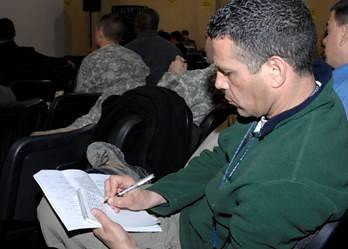 Kabul, Afghanistan—Participants in the PRT Conference held at HQ ISAF listen and take notes on the panel discussion. The conference gives all attendees an opportunity to voice best practices and lessons learned from their respective province. (ISAF photo)

I ended up chatting with the interviewer for quite a while and I'm disappointed that she couldn't find a use for any of the slightly brighter things I said in the interview. I'm also not sure why she didn't get a byline (TSgt Nipper was her name, incidentally) but maybe they're not supposed to do that for a press release. Who knows.
So that was exciting I suppose.
I'll be posting the same story (from my own particularly charming, bitter, little angle) as soon as I get a chance. Stay tuned.
Subscribe to:
Posts (Atom)